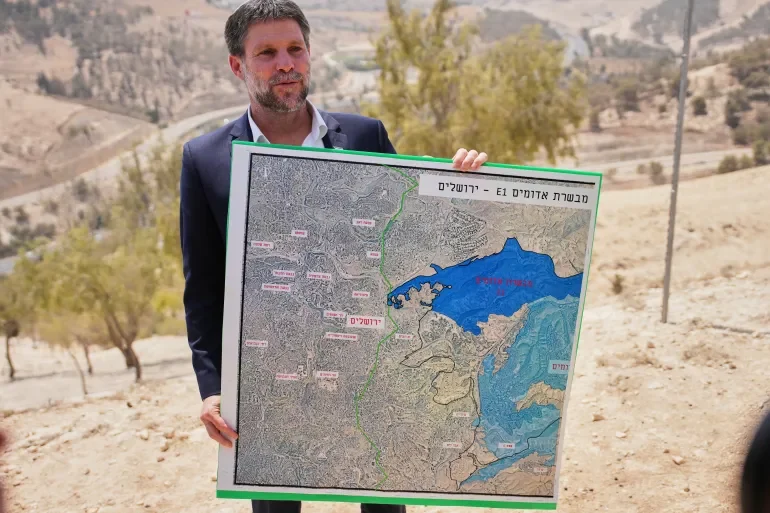
Plans to advance the E1 settlement project in the occupied West Bank have drawn widespread international condemnation, but analysts say the Israeli government and its right-wing allies may see little reason to change course.
The proposed settlement, which is considered illegal under international law by most of the international community, is widely viewed as a threat to the prospect of a viable Palestinian state.
The E1 area lies between East Jerusalem and the large settlement of Maale Adumim, and critics say building there would effectively cut the West Bank in two.
Several governments have issued statements urging Israel to halt the plans, while Palestinian officials have described the project as a direct challenge to a two-state solution.
“For some in the coalition, the outrage is not a deterrent. It can be read as proof that the policy matters.”
Analysts note that for parts of Prime Minister Benjamin Netanyahu's coalition, advancing settlement construction is a long-standing political priority rather than a concession.
Some observers argue that international criticism can strengthen support for the policy among nationalist voters, who view outside pressure as interference in Israeli affairs.
Others caution that the diplomatic costs could accumulate over time, affecting relations with key partners and complicating regional diplomacy.
Israel has historically rejected the view that its settlements are illegal, pointing to historical and security considerations.
The plans have been discussed for decades but were repeatedly frozen, in part because of pressure from Western allies who regarded the area as particularly sensitive. Critics say reviving them now signals a greater willingness to absorb diplomatic costs. Residents of nearby Bedouin communities have also raised fears that they could be forced from land they have lived on for generations.
Planning procedures for the project are expected to continue, with further stages subject to approval by Israeli authorities.